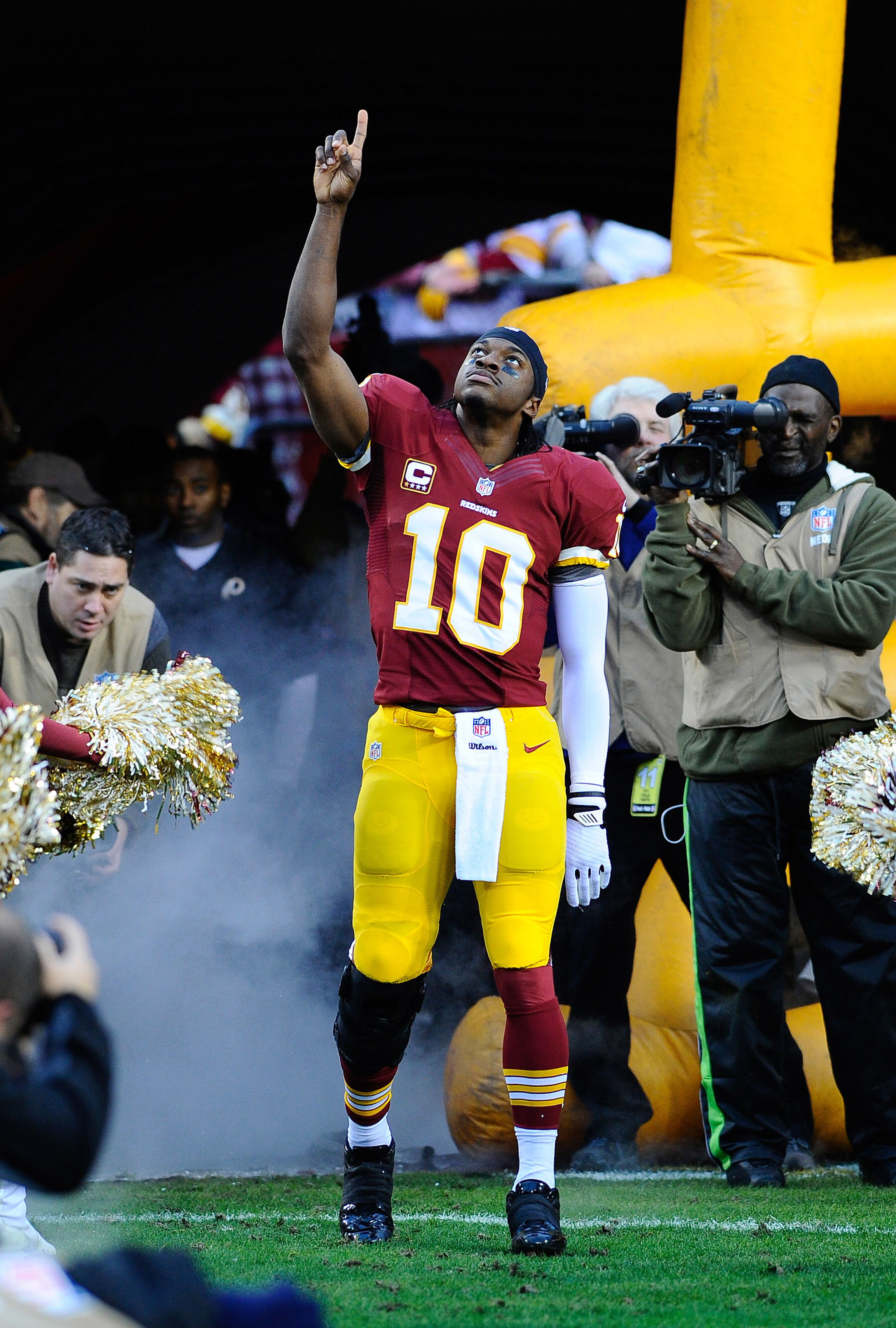

Robert Griffin III
It took Chris Kluwe invoking the specter of “cockmonsters” for the public to realize that their are NFL players who are pro-gay marriage. Kluwe, of the Minnesota Vikings, was defending fellow player Brendon Ayanbadejo for supporting marriage equality in Maryland. Ayanbadejo was criticized for speaking out by politician Emmett Burns, who wrote that “I know of no other NFL player who has done what Mr. Ayanbadejo is doing.”
How wrong Burns is and he was off by more than two dozen. Outsports has identified 28 current NFL players (as well as some free agents and some in management) who have issued support for gays — be it marriage or as teammates or gay rights in general. (Thanks to a reader, we have added Shaun Cody of the Texans to the original list). Some are huge stars, such as Robert Griffin III and Rob Gronkowski, but all have been articulate and thoughtful on the issue.
Get off the sidelines and into the game
Our weekly playbook is packed with everything from locker room chatter to pressing LGBTQ sports issues.
It took Chris Kluwe invoking the specter of “cockmonsters” for the public to realize that their are NFL players who are pro-gay marriage. Kluwe, of the Minnesota Vikings, was defending fellow player Brendon Ayanbadejo for supporting marriage equality in Maryland. Ayanbadejo was criticized for speaking out by politician Emmett Burns, who wrote that “I know of no other NFL player who has done what Mr. Ayanbadejo is doing.”
How wrong Burns is and he was off by more than two dozen. Outsports has identified 28 current NFL players (as well as some free agents and some in management) who have issued support for gays — be it marriage or as teammates or gay rights in general. (Thanks to a reader, we have added Shaun Cody of the Texans to the original list). Some are huge stars, such as Robert Griffin III and Rob Gronkowski, but all have been articulate and thoughtful on the issue.
The number is almost certainly larger — Ayanbadejo estimates that 70% of NFL players support gay marriage (which would be 1,187 players). That’s an impossible figure to verify short of polling all 1,696 players, so we’ll stick with what is in the public realm. Our list represents only people Outsports has interviewed or whose views have been publicized.
Here is our list and citations, followed by a photo gallery of the 28 (if we have missed anyone, post it in the comments or drop me a line).
Brendan Ayanbadejo (Baltimore Ravens): We have written numerous stories on the linebacker and his support for marriage equality. “America is supposed to be the land of the free but in order for this to be true for all of us, then we must have the ability to marry whom we love regardless of their gender,” he said in an ad for gay marriage in Maryland.
LaMarr Woodley (Pittsburgh Steelers): Though a fierce division rival of Ayanbadejo, the linebacker stood up for him when he was attacked by Burns. Woodley took to his Twitter feed to say: “Yall kno im not pro raven about anything, but im sorry this is just crazy and not right!!”
Chris Kluwe (Minnesota Vikings): Now the most famous punter in the league, Kluwe created a media sensation with his letter ripping Burns. Back in June, he did a long and thoughtful Q&A with Outsports on all matters gay. “I don’t think a lot of people realize that family is family. It doesn’t matter who you are; the people you grow up with, that’s your family. If you find out your kid is gay, are you going to love him any less? Because if you do, then you’re probably not doing parenting for the right reasons,” he said.
Ricky Jean Francois, Isaac Sopoaga, Donte Whitner and Ahmad Brooks (San Francisco 49ers): The four defensive players did an It Gets Better video against bullying of gay youth, the first NFL team to cut such an ad. “Every day brings different changes and challenges that define who you are. But something you should never experiences is being bullied, intimidated or being pressured into being someone or something you are not,” they said.
Matt Hasselbeck (Tennessee Titans): The veteran quarterback told Cyd Zeigler of Outsports: “Statistically, it’s a fact that any of us who played in the NFL for a period of time has played with a gay teammate. That’s just a fact. If somebody came out, I think it would be brave of him, because of what the culture has been. But I’m sure we all have.”
Rob Gronkowski (New England Patriots): The stud tight end was initially reticent of talking to Zeigler, afraid of saying the wrong thing. But when asked about having a gay teammate, he said: “If that’s how they are, that’s how they are. I mean, we’re teammates so, as long as he’s being a good teammate and being respectful and everything, that’s cool.”
Robert Griffin III (Washington Redskins): The rookie quarterback who is setting the NFL on fire told Outsports that he once had a gay teammate in high school who quit the team because of it. What did Griffin learn from him? “Just because they’re gay doesn’t mean they’re hitting on you,” he said.
Connor Barwin (Houston Texans): Barwin is a sack master, but also passionate about human rights. He contacted Outsports to talk about marriage equality, proud of his gay brother Joe. In a wide-ranging interview, one quote stood out: “Times are really changing and people are understanding that there’s really no reason to have an issue with [gay marriage]. Embrace who people love and how they love.”
Shaun Cody (Houston Texans): The defensive lineman tweeted this after President Obama came out for gay marriage — “I cant wait to go to my first gay wedding. Decor should be outstanding #BoutTimeObama.” Cody also jokes about sharing the same name as the popular gay porn site Sean Cody.com.
Michael Robinson (Seattle Seahawks): The running back was a bit hard to pin down in Zeigler’s brief interview. While saying he “embraces” gay people, he nonetheless was not sure about the dynamics with an openly gay player in the lockerroom.
Scott Fujita (Cleveland Browns): The ex-Saints linebacker has long been an advocate of marriage equality and gay rights. He told Dave Zirin of the Nation in 2009: “I wish they would realize that it’s not a religion issue. It’s not a government issue. It’s not even a gay/straight issue or a question of your manhood. It’s a human issue.”
Coby Fleener (Indianapolis Colts): The tight end was among a dozen rookies Outsports spoke with an event in Los Angeles. “As long as they competed on the field and gave it their all in practice, that’s all I care about,” Fleener said about a gay teammate. “It’s not something that’s at the forefront of football. But especially at Stanford and in the Bay Area, it’s something you deal with on a regular basis, more so than anywhere else in the United States. So I’m very comfortable with it, whereas in other areas it might not be the norm.”
Trent Richardson (Cleveland Browns): The rookie running back said about having an openly gay teammate — “As long as they’re playing good football and contributing to the team, I don’t have nothing to do with that. It is what it is. I don’t have any problem with any sexuality or whatever they’ve got going on. That’s them. That’s what they want to do. That’s their life.”
LaMichael James (San Francisco 49ers): He echoed what Richardson said — “As long as they help us win on Saturday and Sunday, what they do between them is their business.”
Doug Martin (Tampa Bay Buccaneers): At the same rookie event in L.A., Martin said about a gay teammate, “It wouldn’t really affect me.”
Nick Foles (Philadelphia Eagles): The rookie quarterback also doesn’t care if a teammate is gay, adding, “I’m going to treat them the same way … [football players are] normal people, and we just want to treat people decently.”
T.J. Graham (Buffalo Bills): The rookie receiver sees gay rights as a civil rights issue. “You can’t discriminate. It’s just like black, white, same thing. You wouldn’t discriminate against my race, just like I wouldn’t discriminate against your sexuality.”
Ray Edwards (Atlanta Falcons): The defensive lineman said that if he had a gay teammate, “ I’d be very open to it. … I actually have a lot of friends who are gay. It’s fine with me. I don’t have a problem with it at all.”
Takeo Spikes (San Diego Chargers): The longtime linebacker had an interesting take on having a gay teammate. “Actually, I would like it better [if a teammate came out]. Because I like to be transparent. If it’s something that’s close to your heart, everybody should be transparent about it. You may not agree with what everybody does in life, but you can respect it.”
George Wilson (Buffalo Bills): The safety said it’s all about team and that a gay teammate would be a part of that. “At the end of the day, when you’re one of the guys in the locker room, you’re one of the guys,” he said. “As long as you can stay productive and get the job done, you’re still gonna remain one of the guys.”
Taiwan Jones (Oakland Raiders): The running back has a cousin who is gay, and said about a gay teammate, “as long as he respects me and my space, I have nothing against gay people or what he does in his life and his private time.”
Kamerion Wimbley (Oakland Raiders): The defensive end had some help in accepting gay people. “My ex-girlfriend made me understand how being gay is OK. It’s better for people to be able to be themselves than have to hide in a shell all their lives,” he said.
Evan Mathis (Philadelphia Eagles): The guard was among the Eagles willing to talk about the gay issue with a Philadelphia magazine writer last year. “A lot of guys who are open-minded would be fine with” [a gay teammate], Mathis said. “The way I hear guys talk sometimes, I think some guys might be a little affected by it. I’d be fine with it.”
Eric Decker (Denver Broncos): There is nothing weighty about what Decker said. But in 2011, he was named the world’s hottest athlete by Outsports readers and he tweeted out his thanks to all those who voted for him. Imagine, a straight athlete not uncomfortable with gay guys thinking he’s hot.
Antonio Cromartie (New York Jets): The defensive back was among those athletes who have posed for the NoH8 campaign, designed to raise awareness for gay rights.
In addition, current free agents Donte Stallworth, Nic Harris, Bryan Kehl and Bret Lockett have all expressed gay-positive views. Among management, Giants co-owner Steve Tisch and Patriots owner Robert Kraft have been staunch allies of gay rights, while Ravens owner Steve Bisciotti and President Dick Cass stood by Ayanbadejo after he was attacked for speaking up about gay marriage. And Chicago Bears coach Lovie Smith said he would welcome an openly gay player (“We judge players based on one thing: Can they play football?” Smith said).
Photos of the 27 (click image for larger view):
Photo credits:
Brendon Ayanbadejo (Evan Habeeb-US PRESSWIRE); Ricky Jean Francois (Kyle Terada-US PRESSWIRE); Isaac Sopoaga (Ron Chenoy-US PRESSWIRE); Donte Whitner (Kyle Terada-US PRESSWIRE); Ahmad Brooks (Ed Szczepanski-US PRESSWIRE); Ray Edwards (Daniel Shirey-US PRESSWIRE); Takeo Spikes (Jody Gomez-US PRESSWIRE); George Wilson (Kevin Hoffman-US PRESSWIRE); Taiwan Jones (Jason O. Watson-US PRESSWIRE); Kamerion Wimbley (Kirby Lee/Image of Sport-US PRESSWIRE); Matt Hasselbeck (Jim Brown-US PRESSWIRE); Michael Robinson (Christopher Hanewinckel-US PRESSWIRE); Rob Gronkowski (Kim Klement-US PRESSWIRE); Connor Barwin (Brett Davis-US PRESSWIRE); Robert Griffin III (Derick E. Hingle-US PRESSWIRE).
Trent Richardson (David Richard-US PRESSWIRE); Coby Fleener (Charles LeClaire-US PRESSWIRE); LaMichael James (Brian Spurlock-US PRESSWIRE); Doug Martin (Brian Spurlock-US PRESSWIRE); Nick Foles (Eric Hartline-US PRESSWIRE); T.J. Graham (Hannah Foslien/Getty Images); Scott Fujita (David Richard-US PRESSWIRE); Evan Mathis (Andrew Weber-US Presswire); Eric Decker (Ron Chenoy-US PRESSWIRE); Antonio Cromartie (Debby Wong-US PRESSWIRE); Lamarr Woodley (Charles LeClaire-US PRESSWIRE); Shaun Cody (Kyle Terada-US PRESSWIRE)